The clash between the Roman Empire and the Germanic tribes during antiquity was a pivotal moment in history.
While the Romans were renowned for their military prowess and expansive empire, they faced considerable challenges when dealing with the formidable Germanic tribes.
This article delves into the multifaceted factors that enabled the Germanic tribes to achieve victories against the Romans, highlighting key aspects such as military tactics, leadership, terrain, and sociocultural dynamics.
I. Germanic Tribes: A Brief Overview
A. Diverse Germanic Tribes
The Germanic tribes were a heterogeneous group, comprising numerous distinct tribes such as the Cherusci, Chatti, Suebi, and Marcomanni, each with their own unique cultural and linguistic characteristics.
B. Geographic Location
These tribes inhabited vast regions of Central and Northern Europe, primarily within modern-day Germany, Denmark, and parts of Scandinavia. The geographical diversity of these territories played a crucial role in their resistance to Roman conquest.
C. Socio-cultural Aspects
Germanic tribes were characterized by their fierce warrior traditions, tribal loyalties, and decentralized societal structures. These factors contributed to their ability to adapt to various challenges and exploit Roman weaknesses.
II. The Roman Empire: A Military Goliath
A. Roman Military Structure
The Roman military was renowned for its discipline and organization, with a well-defined hierarchy and extensive training programs for soldiers. The legions were the backbone of Roman military power, known for their cohesion and adaptability.
B. Roman Military Technology
The Romans possessed advanced military technology, including superior weaponry, armor, and siege equipment. Their engineering skills enabled them to build formidable fortifications and roads, facilitating their military campaigns.
C. Roman Expansionism
The Roman Empire’s insatiable appetite for expansion brought it into contact with the Germanic tribes. Roman conquests in Gaul and the Rhineland brought them into direct conflict with these formidable adversaries.
III. Battle of Teutoburg Forest (9 CE)
A. Arminius: The Germanic Hero
Arminius, a Cherusci noble raised in Rome, played a pivotal role in the Battle of Teutoburg Forest. He used his knowledge of Roman tactics to lead the Germanic tribes to victory.
B. Ambush Tactics
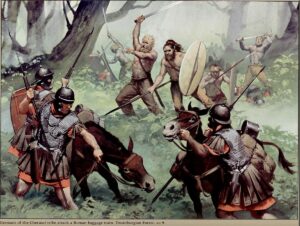
The Germanic tribes employed ambush tactics, luring Roman legions into dense forests where their traditional formations and military discipline were rendered ineffective.
C. Roman Disarray
The battle resulted in the annihilation of three Roman legions, dealing a severe blow to Roman confidence and altering their strategic approach in Germania.
IV. Adaptation to Local Terrain
A. Germanic Familiarity with Forests
The Germanic tribes had an innate understanding of their local terrain, enabling them to navigate dense forests and marshes with ease, whereas Roman legions struggled in such conditions.
B. Marshes as Natural Barriers
The presence of marshes and swamps served as natural barriers, limiting the Romans’ ability to maneuver their legions effectively.
C. Utilizing Geography as a Defensive Advantage
The Germanic tribes exploited the terrain to create chokepoints and ambush locations, capitalizing on their defensive advantages.
V. Divide and Conquer
A. Tribal Fragmentation
The fragmented nature of Germanic tribes prevented the Romans from facing a unified front, as the tribes often had conflicting interests and allegiances.
B. Roman Overextension
The Roman Empire’s vast territorial reach stretched its resources thin, making it difficult to maintain control over distant regions like Germania.
C. Diplomatic Maneuvers
Germanic tribes utilized diplomacy to exploit divisions among Roman commanders, sowing discord and mistrust among Roman allies.
VI. Hit-and-Run Warfare
A. Guerilla Tactics
The Germanic tribes employed hit-and-run guerrilla tactics, ambushing Roman supply lines and harassing their forces.
B. Mobility Advantage
Germanic warriors, often on horseback, had a mobility advantage over Roman foot soldiers, allowing them to strike swiftly and disappear into the wilderness.
C. Elusive Targets
Roman attempts to engage the Germanic tribes in pitched battles often proved fruitless, as the tribes evaded confrontations when the odds were unfavorable.
VII. Psychological Warfare
A. Fear of Barbarians
The Romans held deep-seated fears of the “barbarian” Germanic tribes, which could affect the morale of their troops.
B. Symbolism and Propaganda
The Germanic tribes used symbols and rituals to invoke fear and emphasize their perceived otherness.
C. Psychological Impact on Roman Troops
The unfamiliarity of the terrain, coupled with psychological warfare, created a sense of vulnerability among Roman soldiers, affecting their effectiveness in battle.
VIII. Leadership and Unity
A. Charismatic Tribal Leaders
Charismatic leaders like Arminius inspired loyalty and unity among the Germanic tribes, enabling them to coordinate their efforts effectively.
B. Tribal Alliances
Alliances among different Germanic tribes were formed when a common enemy, like the Romans, threatened their existence.
C. Leadership Decisiveness
Germanic leaders made bold decisions, seizing opportunities and exploiting Roman weaknesses when they arose.
IX. Roman Political Instability
A. Political Intrigue in Rome
Rome experienced periods of political turmoil, including power struggles and assassinations, which weakened its ability to respond effectively to external threats.
B. Roman Leadership Crisis
Incompetent and divided Roman leadership at critical junctures hampered the empire’s response to the Germanic challenge.
C. Diverted Attention
Conflicts on other fronts, such as the Parthian Empire and internal revolts, diverted Roman attention and resources from Germania.
X. Legacy of Germanic Triumphs
A. Impact on Roman Strategy
The defeats suffered in Germania prompted Rome to adopt a more cautious and defensive approach in dealing with external threats.
B. The Decline of the Roman Empire
The ongoing pressure from Germanic tribes, among other factors, contributed to the eventual decline and fall of the Western Roman Empire.
C. Historical Significance
The Germanic victories over Rome had a profound impact on European history, shaping the subsequent development of the continent and its peoples.
XI. Conclusion: The Triumph of Determination
The ability of the Germanic tribes to achieve victories against the Roman Empire was the result of a complex interplay of military tactics, leadership, terrain, and sociocultural dynamics.
The Battle of Teutoburg Forest, in particular, stands as a testament to the resourcefulness and resilience of the Germanic tribes.
While the Romans were a military juggernaut, the Germanic tribes demonstrated that determination, adaptability, and unity could overcome even the mightiest of foes.
The legacy of these conflicts continues to shape our understanding of ancient history and the enduring impact of determined resistance against overwhelming odds.
Leave a Reply