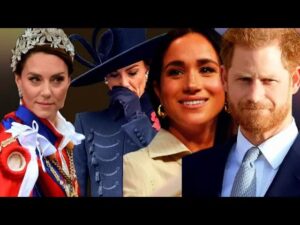
In the world of royal announcements, timing can be everything.
Recently, Kate Middleton unveiled a new early years initiative that has sparked considerable debate.
Some are hailing it as a groundbreaking project, while others speculate it may be a clever distraction from Prince Harry’s upcoming Invictus Games.
As the world gears up for this high-profile event, which showcases the resilience of wounded military personnel, one can’t help but wonder about the motivations behind Kate’s announcement.
The backdrop to Kate’s project is particularly noteworthy.
In just five days, Harry’s Invictus Games will take center stage, an event that has always been close to his heart.
This global competition not only celebrates the athletic prowess of injured veterans but also aims to promote healing through sport.
With such a significant event on the horizon, the timing of Kate’s initiative raises eyebrows and invites scrutiny.
Could it be mere coincidence that Kate’s announcement coincides with this major event?
Or is there a more strategic agenda at play?
In the realm of public relations, the alignment of events can often serve as a tool to capture attention and steer conversations.
By launching her project at this moment, Kate may be attempting to redirect the media spotlight away from Harry’s achievements.
It’s a classic tactic in the game of public perception.
This isn’t the first time we’ve seen William and Kate make headlines in conjunction with Harry and Meghan’s initiatives.
Whenever the Sussexes are poised to garner attention, the Cambridge couple seems to have a new project ready to unveil.
While early years initiatives are undoubtedly important, it’s crucial to examine the underlying motives behind these well-timed announcements.
Are they genuinely aimed at creating change, or are they simply strategic maneuvers to maintain a favorable public image?
As we delve deeper into Kate’s campaigns, we encounter a plethora of buzzwords—terms like “innovative,” “groundbreaking,” and “revolutionary” frequently pepper her messaging.
But what do these terms really signify?
Upon closer inspection, it appears that they often serve more to generate headlines than to reflect substantial progress.
While awareness campaigns can indeed mobilize public support, they must be accompanied by actionable steps to effect real change.
So where is the concrete plan behind Kate’s initiatives?
Where’s the roadmap that outlines how these campaigns will lead to meaningful outcomes?
Unfortunately, amid the grand statements, the specifics seem to be lacking.
It’s akin to being presented with an exquisitely plated dish that ultimately fails to deliver on flavor—visually appealing yet lacking in substance.
Moreover, the media plays a significant role in shaping perceptions surrounding these initiatives.
Far too often, the focus drifts toward Kate’s fashion choices rather than the actual impact of her work.
Headlines routinely highlight her latest outfits, overshadowing discussions about the initiatives she champions.
This trend raises questions about whether this emphasis on appearances serves as a distraction from the lack of tangible results.
Is the media unwittingly complicit in diverting attention away from the core issues?
Or is this merely a reflection of society’s fixation on superficial details?
Regardless, it’s evident that the coverage tends to prioritize style over substance, leaving the real impact of these initiatives in the shadows.
Looking back, one can identify a pattern in the timing of William and Kate’s announcements.
For instance, in 2021, as all eyes were on Harry’s Invictus Games, the Duke and Duchess of Cambridge launched their own mental health initiative.
Similarly, in 2022, just as Harry and Meghan prepared for a tour, another announcement emerged from the Cambridge camp.
Now, with the Invictus Games once again on the horizon, Kate’s early years initiative appears to follow suit.
Is this coincidence, or is there a method to their timing?
While it’s essential to acknowledge the value of mental health, wildlife conservation, and early childhood development, the strategic timing of these announcements raises eyebrows.
Could they be designed to overshadow Harry and Meghan’s endeavors?
In public relations, timing is indeed a potent weapon, and when wielded strategically, it can create a narrative that serves a specific agenda.
As we peel back the layers of this discussion, questions about transparency and accountability emerge.
Where is the evidence of progress?
Are these royal campaigns merely headline-grabbing exercises without real follow-through?
These initiatives should not only spotlight important issues but also yield measurable change.
Without transparency, the public is left wondering whether the impact is as significant as the announcements suggest.
The conversation we’ve had today has covered a lot of ground.
From examining the curious timing of Kate’s initiative to questioning the substance behind the buzzwords, we’ve challenged the media’s focus on fashion over impact.
We’ve also highlighted the recurring patterns in royal announcements and called for greater transparency.
The royal spotlight is undoubtedly a powerful platform, but when used strategically to overshadow others, it raises important ethical questions.
What lies behind the glitzy headlines?
Only time will tell.