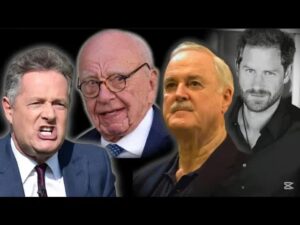
In a world where celebrity feuds often dominate headlines, the latest spat between Piers Morgan and Hugh Grant has taken center stage, drawing in none other than legendary comedian John Cleese.
This confrontation, which has ignited passionate discussions online, revolves around Rupert Murdoch and the ethical dilemmas surrounding his media empire.
So, grab your popcorn because this drama is unfolding in real-time on social media.
John Cleese, known for his sharp wit and iconic role in Fawlty Towers, has entered the fray, labeling Morgan as “lazy” and “sloppy.” This commentary comes amidst a heated exchange between Morgan and Grant that has spilled over onto X, the platform formerly known as Twitter.
The roots of their conflict can be traced back to a recent announcement by the UK government, which decided against reopening the Leveson Inquiry—a public investigation into journalistic ethics sparked by the notorious phone-hacking scandal.
For those unfamiliar with the Leveson Inquiry, it was established to address serious concerns regarding press conduct, particularly in relation to Murdoch’s media outlets.
Grant, a long-time critic of Murdoch, has been vocal about his desire to revive scrutiny on media practices, especially given the recent legal troubles faced by Murdoch’s flagship newspaper, The Sun, which recently settled a lawsuit with Prince Harry over phone-hacking allegations.
In response to the government’s stance, which was articulated by Defence Secretary John Healey, Grant expressed frustration.
During an interview on Radio 4, he remarked on the fear politicians seem to have regarding Murdoch’s influence, suggesting that they are hesitant to confront such a powerful figure.
His comments underscore a growing concern about the entanglement of politics and media in the UK.
Morgan, never one to shy away from controversy, quickly took to X to rebut Grant’s claims, accusing him of hypocrisy.
Morgan pointed out that Grant had previously profited from projects associated with Murdoch, casting doubt on his criticisms.
However, Grant wasted no time in defending himself, clarifying that he hadn’t worked for any Murdoch-owned company since 1994 and had consistently turned down offers since then.
The exchange escalated further when Morgan claimed that Grant’s film Florence Foster Jenkins had been distributed in the UK by a Murdoch-owned company, insinuating that Grant’s anti-Murdoch stance was disingenuous.
Grant shot back, explaining that the film was made for the BBC and Pathé, emphasizing that he had no control over distribution deals.
His retort was sharp, leaving little room for misinterpretation.
On January 25th, Cleese added his voice to the debate, tweeting his thoughts on the matter.
He highlighted the contrast between what he sees as a well-informed perspective versus Morgan’s approach, which he deemed lazy.
Cleese’s remarks resonate with many who appreciate his intellectual rigor and candidness in public discourse.
Both Cleese and Grant have been involved with Hacked Off, an organization advocating for a more accountable press in the UK.
This group emerged in the aftermath of the phone-hacking scandal, seeking to hold media giants accountable for their actions.
Despite ongoing criticism, Murdoch’s News Group Newspapers maintains that it has not engaged in any illegal practices, a claim that continues to be met with skepticism.
This feud is not merely a clash of personalities; it reflects deeper issues concerning media power dynamics and political accountability.
It raises significant questions about how media moguls like Murdoch can shape narratives and influence public opinion, often without sufficient oversight or challenge from those in power.
As Morgan defends Murdoch, his rhetoric raises eyebrows, particularly as he positions himself as a champion of free speech while seemingly ignoring the implications of media consolidation.
Critics argue that this duality illustrates a troubling trend in which the interests of powerful media figures overshadow the public’s right to unbiased information.
Ultimately, this ongoing saga between Morgan, Grant, and Cleese serves as a microcosm of larger societal issues.
It’s a reminder of the intricate web connecting media, politics, and individual responsibility.
As we witness these public figures navigate their differences, it’s crucial to reflect on who truly advocates for the public interest amidst the noise of celebrity squabbles.
Stay tuned as this story develops, and remember, the implications of this feud extend far beyond entertainment.
It’s a conversation about power, ethics, and the future of journalism itself.