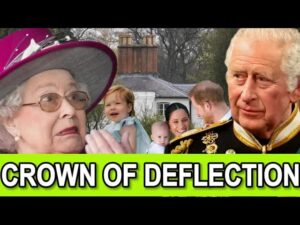
In a troubling twist of royal narrative, King Charles appears to be deflecting responsibility for contentious decisions onto his late mother, Queen Elizabeth II.
This strategy has come to light particularly in discussions surrounding the eviction of the Duke and Duchess of Sussex from Frogmore Cottage.
By insinuating that the late Queen intended for Harry and Meghan to be removed from their UK residence, Charles seems to be trying to distance himself from a decision that many view as harsh and unpopular.
This tactic raises eyebrows, as it shifts the blame onto a figure who can no longer defend her legacy or clarify her intentions.
It not only risks misrepresenting the late Queen’s wishes but also casts doubt on Charles’s readiness to own his decisions as the reigning monarch.
The assertion that the Queen had planned to evict the Sussexes contradicts her earlier gesture of gifting them Frogmore Cottage, hinting at a deliberate revision of history aimed at softening public backlash against Charles’s actions.
As public discontent grows over a series of controversial choices made by the King, his correspondents seem increasingly disillusioned with his leadership.
British journalists, including Robert Hardman, have been vigorously defending the King’s decisions, but many see these narratives as questionable attempts to obscure the truth.
Hardman’s updated book claims that the Queen herself had intended to evict the Sussexes, a narrative that conveniently shields Charles from accountability for what many consider an unjust move.
However, this narrative clashes with established facts.
The Sussexes had a legitimate lease on Frogmore, invested in its renovation, and received it as a gift from the Queen.
By suggesting that she intended to terminate their lease and relocate Prince Andrew to the cottage, Charles appears to be retroactively justifying his own decision while evading criticism.
Such a calculated maneuver not only contradicts the Queen’s known generosity but also seems like a transparent effort to rewrite recent history in favor of the King.
It’s important to remember that Robert Hardman is a close ally of Charles, and his narratives often favor the royal family.
The eviction of the Sussexes from Frogmore, a place they considered their safe haven in the UK, highlights how Charles has failed to protect Harry, Meghan, and their children as part of the royal family.
Hardman’s latest work has been criticized for perpetuating falsehoods that attempt to absolve Charles of his unreasonable decisions.
The claim that the late Queen had planned this eviction feels suspiciously timed and self-serving.
It starkly contradicts the reality that the Sussexes were given Frogmore as a gift and had invested in its upkeep.
By suggesting that the Queen wanted to replace them with Prince Andrew, Charles seems to be sanitizing his own unpopular choice while simultaneously placing it on his mother’s shoulders—who, conveniently, cannot refute these claims.
Charles’s staff has been vocal about the support offered to the Sussexes, reinforcing this defensive approach.
This narrative aims to absolve the monarchy of any responsibility regarding the couple’s departure from royal duties.
However, it raises questions about the authenticity of these claims and whether they serve more to shield Charles than to reflect the true nature of events.
Additionally, Hardman’s portrayal of King Charles as a model of restraint amidst ongoing criticism from the Sussexes appears misleading.
Reports suggest that Charles maintained a strategy of non-engagement, opting to avoid stirring the pot with Harry and Meghan.
Yet, the royal family has consistently criticized the couple even after their decision to step back from royal duties.
This contradiction suggests a deeper frustration within the monarchy, stemming from the Sussexes’ continued prominence outside the institution.
The narrative crafted by Hardman paints Charles in a favorable light, depicting him as stoic while framing the Sussexes as the instigators of conflict.
This portrayal is not only unfair but also indicative of a larger pattern where the royals collaborate with the media to undermine Harry and Meghan’s reputation.
The question remains: will the British media ever confront the challenges lurking within the monarchy itself?
Ultimately, the alleged plans to evict the Duke and Duchess of Sussex from Frogmore Cottage conveniently shift responsibility for this unpopular decision onto the deceased monarch.
Yet, it was Charles who executed the eviction long after the Queen had passed.
His attempts to rewrite history extend even to Harry’s recent visit, where he allegedly offered accommodation that Harry declined due to security concerns.
By framing these events in such a way, Charles appears to be attempting to absolve himself of accountability for widely criticized decisions while portraying the Sussexes as ungrateful.
This approach raises serious ethical questions about the integrity of the royal narrative and the lengths to which Charles may go to protect his image.
As the drama continues to unfold, the public is left wondering about the true motivations behind these royal maneuvers.