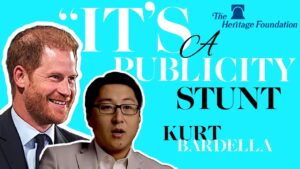
In a recent ruling, a court dismissed the Heritage Foundation’s attempt to access Prince Harry’s immigration records, much to the relief of his many supporters.
This decision has sparked conversations about the contrasting attitudes toward public figures in the United States compared to the United Kingdom.
Prominent political commentator Kurt Bardella has been particularly vocal about this outcome, noting that the American public largely views the situation with indifference.
The Heritage Foundation, a conservative think tank, made headlines with its controversial bid to scrutinize the Duke of Sussex’s immigration status in the U.S.
However, this move has been widely interpreted as a publicity stunt, lacking any substantial backing.
Bardella argues that the public’s interest in Prince Harry’s immigration status is minimal, especially when compared to the tabloid frenzy in the UK.
Bardella’s remarks resonate with many Americans who appreciate Prince Harry not for any scandal but for his advocacy work and humanitarian efforts.
This admiration starkly contrasts with the obsession displayed by UK tabloids, which often thrive on sensationalism and drama surrounding royal figures.
The dismissal of the Heritage Foundation’s case serves as a reminder of the disconnect between American and British media landscapes.
The governance styles in the U.S. and the U.K. also play a crucial role in shaping public perception.
In America, privacy rights are often respected, particularly concerning residency and immigration issues.
This stands in sharp contrast to the relentless scrutiny faced by public figures in Britain.
Bardella emphasizes how these differing values influence how the public perceives Prince Harry’s situation.
Culturally, the U.S. adopts a more relaxed approach to celebrities compared to the U.K., where tabloids have a long-standing history of intruding into the personal lives of public figures.
Bardella highlights that this cultural divide is essential for understanding why Prince Harry’s situation seems less significant in the U.S. than in the U.K.
Moreover, the support for Prince Harry in the U.S. acts as a protective barrier against media attacks.
Many Americans refuse to tolerate unjust scrutiny against someone they admire.
This public backing serves as a counterbalance to the efforts of the Heritage Foundation and the British tabloids.
Social media has emerged as a powerful tool in shaping public sentiment.
Supporters of Prince Harry leverage digital platforms to amplify his narrative, creating a community that stands firm against tabloid attacks.
Bardella’s engagement on social media reflects this trend, showcasing how these platforms empower both public figures and their advocates.
The court’s dismissal of the Heritage Foundation’s claims sets a legal precedent that underscores the importance of privacy rights in the U.S.
This decision sends a clear message that public figures deserve protection regarding their personal information, a principle Bardella champions in his defense of Prince Harry.
Bardella urges a broader understanding of the implications of this case, suggesting that the focus should shift from Prince Harry’s immigration status to the values of compassion and respect for privacy.
His perspective encourages a move away from sensationalism toward a more nuanced understanding of public figures.
As the dust settles from the court’s decision, Prince Harry’s future in the U.S. appears secure.
Bardella confidently reassures fans that the Duke of Sussex will not face deportation, allowing him to continue his advocacy work without the looming threat of legal troubles.
The dedication Prince Harry shows to mental health initiatives has endeared him to many Americans, solidifying his status as a beloved figure.
In the U.S., family decisions are often respected, granting individuals the autonomy to shape their destinies.
Bardella stresses that this principle applies to Prince Harry and his family, asserting that their choices should not be dictated by media narratives or external pressures.
The Heritage Foundation’s reaction to the court’s ruling has been one of frustration, as their attempts to undermine Prince Harry have backfired.
Bardella characterizes their actions as desperate publicity stunts, revealing a lack of credibility behind their claims.
This failure highlights a significant shift in how royal figures are perceived, as audiences grow increasingly discerning and less susceptible to sensationalism.
Kurt Bardella’s unwavering support for Prince Harry sends a robust message of resilience.
By standing against negative media coverage, he amplifies the call for compassion and understanding, encouraging others to join in supporting those facing unjust scrutiny.
As Prince Harry continues to navigate his life in the U.S., the backing of figures like Bardella and the indifference shown by the American public signal a new chapter for the Duke of Sussex—one marked by the freedom to pursue his passions without the burden of tabloid intrusion.